Low-Power Induction Cooktop Meals for 100Ah Lithium Battery Setups
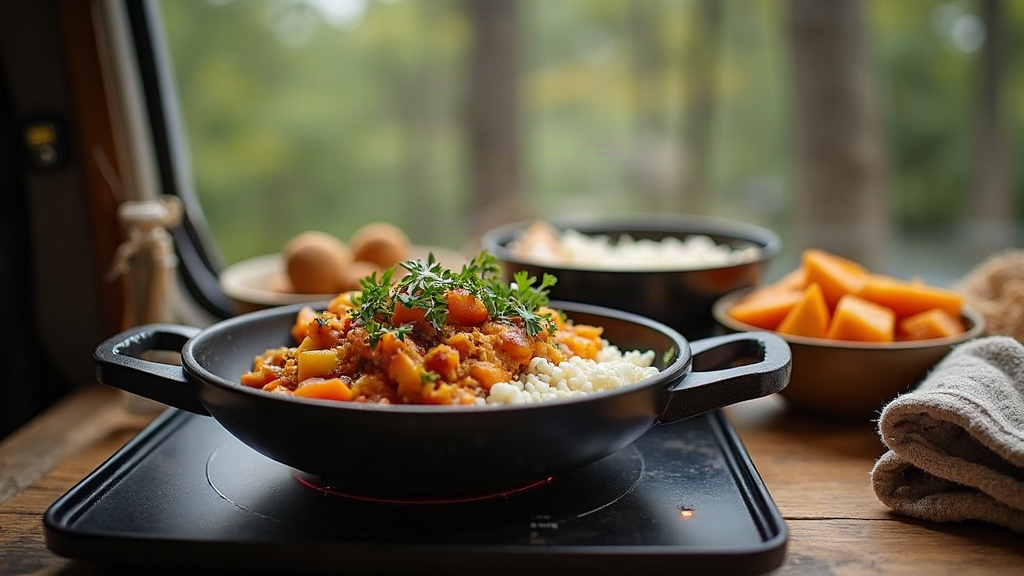
Understanding Your 100Ah Lithium Power Budget
Run your camper, van, boat, or off-grid cabin on a single 100Ah lithium battery and you can still cook proper meals on an induction cooktop. The catch? You need to actually know your numbers and pick recipes that fit your power budget instead of just cranking the dial to “high” and hoping for the best.
A single 100Ah lithium (LiFePO4) battery at 12V gives you roughly 1,200 watt-hours of usable energy. Unlike lead-acid, lithium lets you discharge down to 80-100% depth of discharge, so you’re actually getting that full number in practice, not some theoretical max you’ll never touch. Here’s what that looks like at different wattages:
- At 1,000 watts, you get about 1 hour of cooking time
- At 500 watts, you get about 2 hours
- At 300 watts, you get nearly 4 hours
Most portable induction cooktops have a “low” setting somewhere between 300-600 watts, and that’s your sweet spot for battery-friendly cooking. Induction itself isn’t the problem. The problem is the 1,500-1,800 watt “boost” mode that chews through a 100Ah bank in under an hour flat.
Why Induction Still Wins for Battery Setups
You’d think managing wattage so carefully would make induction a pain compared to propane or a resistive electric stove. Actually, it’s the opposite:
- Near-zero wasted heat. Induction heats the pan, not the air around it, so you’re not burning watt-hours warming up your kitchen.
- Fast boil times even at mid-power, which means shorter total cook sessions overall.
- Precise wattage control. You can dial in exactly 300W, 600W, or 900W rather than eyeballing a flame or a dial marked “medium-high.”
That precision is really the whole trick here. It’s what turns “can I cook on this battery” into an actual plan instead of a gamble.
Low-Power Meals That Actually Work
1. One-Pot Lentil and Vegetable Stew (300W, ~35 minutes)
Toss in lentils, diced carrots, onion, and canned tomatoes, then let it simmer on low. Lentils don’t need a rolling boil at all. A gentle simmer at 300W cooks them through in about 35 minutes, costing you roughly 175Wh out of your 1,200Wh budget. That’s less than 15% of your total capacity for a full pot of stew.
2. Steamed Rice with Canned Fish (400W, ~20 minutes)
Use the absorption method: bring rice and water to a brief boil at 600W for 3 minutes, then drop down to 300W, cover, and leave it for the remaining 15 minutes. Total draw stays under 150Wh, which is a cheap way to get a filling dinner on the table.
3. Pan-Seared Eggs and Greens (300W, ~8 minutes)
A cast-iron or stainless pan on low-medium induction power sears eggs and wilts spinach in minutes. This is the cheapest meal on the whole list, under 50Wh. If you’re trying to save power for later in the day, this is the move.
4. Slow-Simmered Oatmeal (250W, ~15 minutes)
Good for mornings when you want to bank your watt-hours for the rest of the day. Oatmeal just wants gentle, steady heat. No need to crank the wattage.
5. Single-Serving Pasta (500W, ~12 minutes)
Use less water than you normally would and keep the lid on. That alone cuts boil time and power draw by close to 30% compared to cooking it uncovered in a full pot of water.
Tips to Stretch Every Watt-Hour
- Use a lid. Seriously, this one change alone makes a bigger difference than most people expect.
- Match pan size to burner. An oversized pan wastes energy heating cooktop surface you’re not even using.
- Pre-soak grains and legumes. Soaked rice or beans cook faster, which means fewer wattage-minutes on the clock.
- Batch cook. Make double portions once instead of firing up the cooktop twice to reheat leftovers.
- Monitor with a power meter. A cheap inline watt meter shows you real-time draw, so you’re not guessing whether you’re at 300W or secretly at 550W.
How Many Meals Can You Cook Per Charge?
With decent planning, a fully charged 100Ah lithium battery can realistically carry you through 3-4 low-power meals in a day (breakfast, lunch, dinner, and a snack), assuming nothing else heavy is pulling from the same bank, no fridge compressor cycling constantly, no inverter running a space heater in the background. If you’ve got solar panels, timing your cooking to daylight hours stretches this even further, sometimes to the point where you’re barely touching stored capacity at all.
Conclusion
Cooking off a 100Ah lithium battery doesn’t mean bland, rushed food. It means cooking with a bit more intention. Stick to the 300-600 watt range, keep lids on your pots, pre-soak what you can, and lean into dishes that naturally want low-and-slow heat, stews, rice, eggs, oatmeal. Do that and you’ll eat well without draining your power bank by dinnertime. There’s no special gadget that fixes this for you. It just comes down to matching what you cook to what your battery can actually give you.