Havelock Wool vs Thinsulate: Best Sound Deadening for Promaster Vans
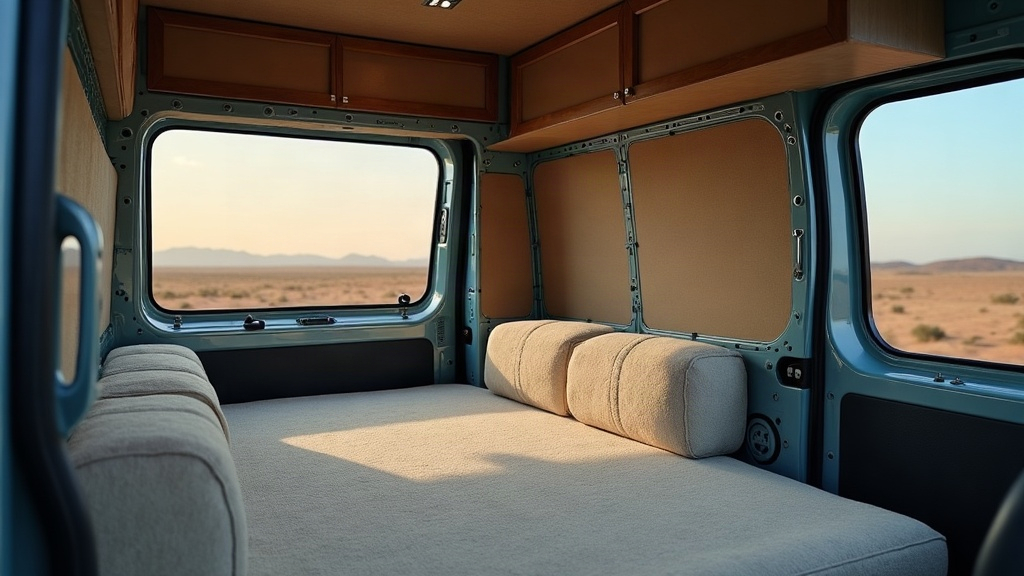
If you’re building out a Ram Promaster and want fewer decibels of highway drone at 70 mph, here’s the short version: Havelock Wool gives you noticeably better acoustic dampening than Thinsulate. It’s denser, so it absorbs mid-to-low frequency road noise more effectively. Thinsulate, on the other hand, wins on thermal performance and installation speed, but acoustically it’s thinner stuff. Most builders who’ve been through a few conversions end up combining the two, or layering in a dedicated sound-deadening product like Dynamat or Kilmat underneath either one, because frankly neither material was built from the ground up to be a sound barrier.
Why Promaster Vans Are So Loud on the Highway
Anyone who’s driven a stock Promaster at highway speed knows the drill. The cabin gets loud, fast. A few reasons why:
- Large flat steel panels that resonate like a drum
- Minimal factory sound deadening in the cargo area
- Wind noise around the boxy, high-roof shape
- Road and tire noise transmitted directly through the thin sheet metal floor and wheel wells
That’s why insulation choice matters so much more here than it would in, say, a passenger SUV that already comes with factory sound insulation baked in. In a Promaster, you’re starting from near zero.
Havelock Wool: How It Performs Acoustically
Havelock Wool is a natural sheep’s wool insulation marketed directly to van and tiny-home builders. It earns its reputation acoustically for a few concrete reasons:
- Density: wool fibers pack denser per cubic inch than Thinsulate, which means they absorb mid-range frequencies (engine hum, road rumble) instead of just bouncing them around the cabin.
- Fiber structure: the crimped, irregular shape of wool fiber traps sound waves and turns vibration into a tiny bit of heat, which cuts down resonance inside wall and ceiling cavities.
- Thickness options: Havelock sells it loose-fill or in batting, at thicknesses from 1.5” to 3”, so builders can pack cavities tighter where they want more dampening.
Real-world feedback from Promaster owners who’ve installed it tends to repeat the same word: “dulling.” Not silence, nobody’s claiming that, but a noticeable softening of road noise and fewer high-frequency rattles making it into the cabin.
Downsides of Havelock Wool
- More expensive per square foot than Thinsulate
- Heavier, which matters if you’re chasing every pound on a weight-sensitive build
- Needs vapor-permeable facing, otherwise it holds moisture
Thinsulate SM600L: How It Performs Acoustically
3M’s Thinsulate, specifically the SM600L automotive-grade version, is the default choice for thermal insulation in van builds. It’s also what a lot of OEM upfitters use. Acoustically though, the story’s different:
- It’s light and low-density, great for trapping air and boosting R-value, but not as good at soaking up low-frequency road drone.
- It handles high-frequency noise (wind whistle, small rattles) better than it handles that constant low hum from the road.
- Because it compresses so easily, sloppy installation can leave gaps, and noise finds those gaps.
Downsides for Acoustic Use
- Less acoustic mass means more road noise simply passes through, compared to wool
- 3M never designed it as a sound barrier, it’s a thermal and moisture-control product first
Side-by-Side Comparison
| Factor | Havelock Wool | Thinsulate SM600L |
|---|---|---|
| Acoustic dampening (low freq road noise) | Better | Moderate |
| Thermal R-value | Good | Excellent |
| Weight | Heavier | Lightweight |
| Cost per sq ft | Higher | Lower |
| Moisture handling | Needs airflow | Hydrophobic, dries fast |
| Installation ease | Moderate (loose fill messier) | Easy (batting, staples well) |
What Actually Works Best: A Layered Approach
Here’s the thing most first-time builders miss: insulation alone, whichever kind you pick, never fully solves the noise problem. The panels themselves are vibrating. Experienced Promaster builders usually stack three things:
- Constrained-layer damper (Dynamat, Kilmat, or Noico) applied straight onto bare metal, floor, and wheel wells. This is the layer that actually stops the metal from resonating in the first place, something no insulation can do on its own.
- Havelock Wool in the wall and ceiling cavities, for thermal comfort and that extra bit of sound absorption.
- Thinsulate tucked into tight spots, like door panels and curved sections, where its compressibility makes it easier to stuff in than wool.
This combo tackles two separate problems at once: vibration damping (killing the noise at its metal source) and sound absorption (soaking up whatever noise is left before it bounces around the cabin). Wool or Thinsulate by themselves only ever handle half of that equation.
Which Should You Choose?
- Go with Havelock Wool if a quiet cabin is your top priority and you can live with the added cost and weight.
- Go with Thinsulate if you’re optimizing for heat retention, keeping the build light, and moisture resistance, and you’re fine adding a separate sound-deadening mat to handle the noise side.
- Use both if you want the quietest, most comfortable Promaster you can build. This is basically the standard approach at most high-end conversion shops.
Conclusion
When it comes strictly to highway road noise, Havelock Wool beats Thinsulate on its own, thanks to its denser fiber structure and stronger absorption at low frequencies. That said, neither one replaces a real vibration-damping layer on bare metal; skip that step and you’ll still hear the panels singing at 70 mph. The quietest Promaster builds run a three-part system: damping mats on the metal, wool or Thinsulate as the insulating and absorbing layer, and careful attention to sealing gaps around doors and windows, since that’s where wind noise sneaks in no matter how good your insulation is. If your budget and payload allow it, pairing Havelock Wool with a damping mat is probably the single best upgrade you can make for a quieter ride at highway speed.