Storing Adjustable Dumbbells and Resistance Bands in a SWB Campervan
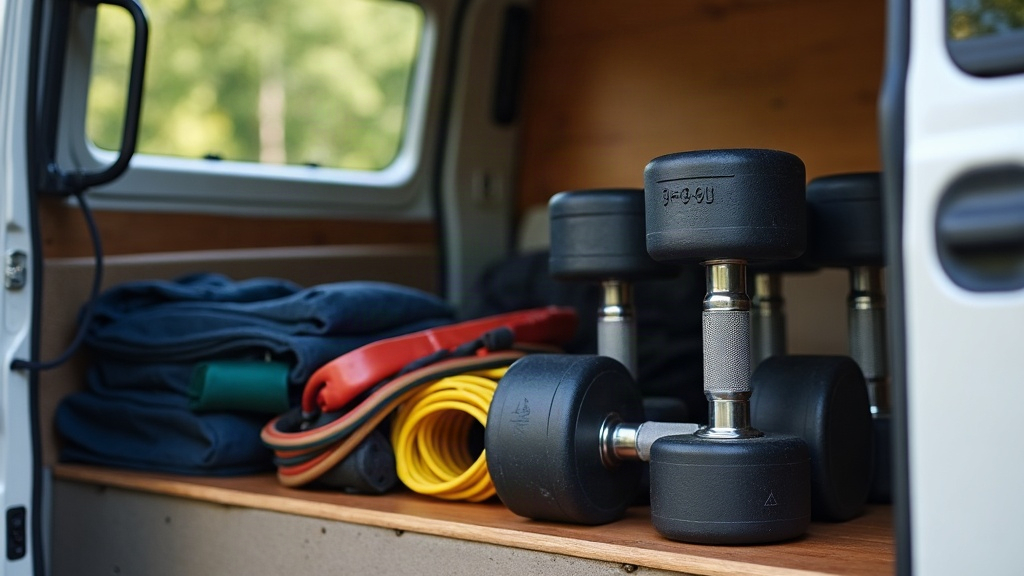
How to Store Adjustable Dumbbells and Resistance Bands in a Short-Wheelbase Campervan
Storing adjustable dumbbells and heavy resistance bands in a short-wheelbase (SWB) campervan isn’t complicated, but it does take some planning. Get the weight distribution right, anchor things securely, and lean on furniture that pulls double duty. Floor space is tight and payload limits are strict, so the real trick is treating your gym gear exactly like you’d treat any other heavy cargo: low, centered, and locked down tight.
Why Storage Strategy Matters in a SWB Van
A short-wheelbase van, think Ford Transit Custom, VW Transporter, or ProMaster City, usually gives you somewhere between 100 and 130 cubic feet of usable interior space. That’s not a lot once you’ve added a bed, a galley, and storage for clothes. Every cubic inch counts, and heavy items like dumbbells don’t just take up room, they shift your center of gravity. Slam the brakes without securing a 30-lb dumbbell and it becomes a projectile, not a workout tool.
Unlike setting up a home gym, you’re not just organizing here, you’re juggling a few extra variables:
- Payload capacity: Even compact adjustable dumbbell sets can run 20-50+ lbs per unit. That adds up fast once you throw in bands, a mat, and maybe a pull-up bar.
- Rattling and noise: Nothing kills the peace of a quiet drive like loose plates clanking around every time you hit a pothole.
- Accessibility: You want your gear within reach without having to unpack the entire kitchen just to grab a 15-pounder.
Best Storage Zones for Dumbbells
1. Under-Bed Platform Storage
This is the single best spot, hands down. It keeps weight low and centered, which is exactly what you want for vehicle stability on winding roads. Set it up with:
- Heavy-duty drawer slides rated for 100+ lbs (cheap slides will bow and jam within a few months)
- A shallow, wide bin lined with rubber matting so plates don’t clang against metal or wood
- Foam cutouts or dividers if your dumbbells have loose weight plates that like to shift around
2. Rear Cargo Nook (Behind Wheel Wells)
Wheel well cutouts leave behind awkward dead space most people ignore. Don’t. It’s practically begging for a custom-built dumbbell cubby. A plywood box with a lid, bolted straight to the floor, stops weights from sliding every time you take a corner a bit too fast.
3. Galley Cabinet Base
If your kitchen cabinets sit low and roughly at the van’s center, reinforce the base shelf with a plywood insert and put dumbbells there instead of pots and pans. Cookware is lighter anyway and handles higher placement just fine.
Pro tip: Always keep heavy items below the axle line, never in overhead cabinets. Stack dumbbells up high and you raise your rollover risk while putting serious strain on cabinet hardware that was never built for 15+ lb loads in the first place.
Storing Resistance Bands Without Tangles
Bands are lighter and easier to deal with logistically, but they have a talent for turning into a knotted mess the second you look away. A few fixes that actually work:
- Door-mounted pouch organizer: A canvas shoe organizer, or a proper gym-band pouch, hung on the inside of a cabinet or closet door keeps bands sorted by resistance level and visible at a glance.
- Labeled stuff sacks: Color-coded drawstring bags, one per resistance level, keep bands from merging into a single tangled ball.
- Vacuum-seal for bulk sets: Carrying several loop and tube bands at once? A vacuum storage bag squashes them down to a fraction of their size. Great for seasonal gear you’re not touching every day.
- Carabiner clip system: Clip bands in pairs to a single D-ring mounted inside a cabinet. Does away with the “spaghetti drawer” problem entirely, and it takes maybe five minutes to set up.
Securing Everything for Driving Safety
Before you pull out onto the highway, run through this:
- Latches on every bin. Spring-loaded or magnetic catches stop lids from popping open the moment you hit a speed bump.
- Non-slip liner under every dumbbell container, as a backup in case a latch ever fails.
- Strap-down points. A handful of D-rings or eye bolts installed in your under-bed storage let you strap larger dumbbell sets directly to the floor.
- Weight check. Look up your van’s payload sticker (usually on the driver door jamb) and make sure total gear weight, fitness equipment included, stays comfortably under that number.
Dual-Purpose Furniture Ideas
SWB vans have zero room for furniture that only does one job. Worth considering:
- A bench seat with a lift-top that stores dumbbells and bands underneath while doubling as a surface for floor exercises.
- A fold-down door-mounted rack that holds resistance bands flat against a wall, clearing up floor space completely.
- A modular milk-crate system secured with ratchet straps. Crates stack neatly, cost almost nothing, and pull out easily when you want to do a quick workout outside instead.
Quick Setup Checklist
- Weigh your full dumbbell and band collection before loading anything in
- Place dumbbells below axle height, as close to the van’s center as you can manage
- Use lined, latched containers, never leave anything loose on a shelf
- Separate bands by resistance level in labeled pouches
- Add floor anchor points for extra security once you’re off smooth pavement
Final Thoughts
Fitting adjustable dumbbells and resistance bands into a SWB campervan comes down to smart placement more than clever containers. Keep the weight low and centered, lock everything down against movement, and pick storage solutions that also function as furniture. Get that right and you can keep up a real strength routine on the road, no sacrificing cabin space, no compromising on driving safety.